Title
Content




Title
Content
Do you have a genuine grasp of UV technology's mechanics? Is your current operational approach comprehensive enough to address the needs of diverse settings? Are you leveraging the technology to its maximum capacity?
Given that UV disinfection is not an exact science, achieving ultimate results hinges on assessment and modifiable configuration. We will delve into the complexities of UV technology for environmental disinfection and outline strategies to maximize your return on investment. UVD Robots provides a unique approach to implementation, optimizing the investment in its technology.
Achieving the necessary UV-C dose to inactivate target organisms in a specific environment depends on several interconnected factors: exposure time, distance, surface orientation, microbial characteristics, lamp strength, operational health of the device, and human behavior1. This raises the question of how each factor can impact the ultimate goal of surface decontamination. Before we drill down into the factors, let’s discuss how different environments influence the spectrum of organisms expected to be present.
The ubiquity of microorganisms, both problematic and benign, necessitates targeted environmental control. In healthcare settings, the primary concern is reducing bioburden of organisms that transmit disease or antibiotic resistance2. Conversely, in aseptic cleanrooms, the focus is on minimizing all bacterial environmental contaminants3. Therefore, the crucial initial step in UV-C disinfection is accurately determining your specific microbial targets.
Microorganisms possess a diverse hierarchy of susceptibility to UV-C light. This resistance spectrum ranges from the most resistant (fungal spores, followed by bacterial spores, mycobacteria, non-enveloped viruses, and certain UV-resistant bacteria) to less resistant forms (yeast, vegetative gram-negative and gram-positive bacteria, and the most susceptible, enveloped viruses).4
The appropriate UV-C dose is directly dependent on the environment and the identified microbes of concern. For instance, hospital inpatient units frequently harbor highly persistent Clostridioides difficile spores on surfaces, demanding a significantly higher UV-C dose to achieve a clinically relevant bioburden reduction. In contrast, outpatient facilities may prioritize organisms like Methicillin-Resistant Staphylococcus aureus or Influenza virus, which require lower doses.
This site-specific dose principle also applies to non-healthcare environments. Cleanrooms, for example, often contend with Aspergillus pernicillioides5, a fungus known for its high UV resistance, necessitating a higher dose than is typical for vegetative bacteria.
While determining the precise UV-C dose for every organism can seem complex, extensive reference materials6, including both long-standing and recent research, are available. These studies clearly outline the UV dose requirements for a wide array of organisms and serve as excellent guides. Ultimately, effective UV-C disinfection hinges on a comprehensive understanding of the targeted environment, the specific high-risk organisms present, and the precise UV dose required for their inactivation.
Once the necessary UV dose is determined based on the target organisms in a given environment, the physical factors of UV implementation must be considered.
Key physical factors7 that influence disinfection time include:
Distance
The inverse square law8 dictates that light intensity decreases rapidly with distance. Specifically:
This makes it crucial to position the light source as close as possible to the environmental surface.
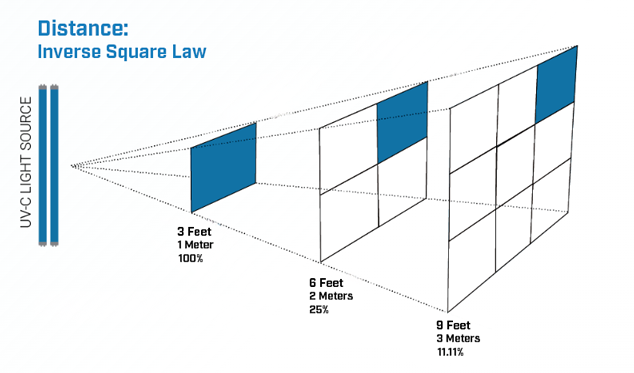
To achieve optimal proximity in any room size, the device often requires multiple position changes. For static devices, this manual movement by an operator adds time to the overall room disinfection process.
When devices are left stationary and centrally located without repositioning, longer disinfection times are necessary. This extended time is required for distant surfaces (e.g., 9 feet away, receiving only 11% intensity) to accumulate the required UV-C dose. Consequently, surfaces closer to a centrally positioned static device may receive an unnecessary overexposure of UV-C irradiation.
Autonomous UV-C devices eliminate the need for manual repositioning. These devices use pre-mapped disinfection points throughout a room, ensuring they are positioned within three feet of the target surface. If high-touch surfaces are not within this three-foot range, the autonomous device's disinfection time can be customized for that specific point, increasing UV exposure to compensate.
Orientation
UV-C light is most effective when directed perpendicular to a surface. However, in a real-world environment, high-touch areas in a room may be in direct line of sight, angled, or even shadowed. Furthermore, surfaces can be oriented horizontally or vertically at various degrees9. Therefore, a careful assessment of the room's disinfection needs is essential, and adjustments must be made accordingly.
This is where the modifiable configuration of the UV-C device's functionality becomes crucial. Does the device allow changes to its disinfection points based on line of sight and surface orientation? Or does it apply a uniform amount of UV-C for a fixed time, regardless of the room's specific layout?
The ideal UV-C device should be adjustable to deliver the precise, targeted dose of UV-C to every high-touch area within the room. This adaptation should be verified using UV-C dosimeters placed strategically throughout the space10. These dosimeters, depending on the type used, will provide either a qualitative or quantitative measure of the UV-C dose reaching that critical surface. Flexibility in the device's operation is the key to spatial optimization, a capability offered by autonomous UV devices but not by static ones.
Lamp Strength
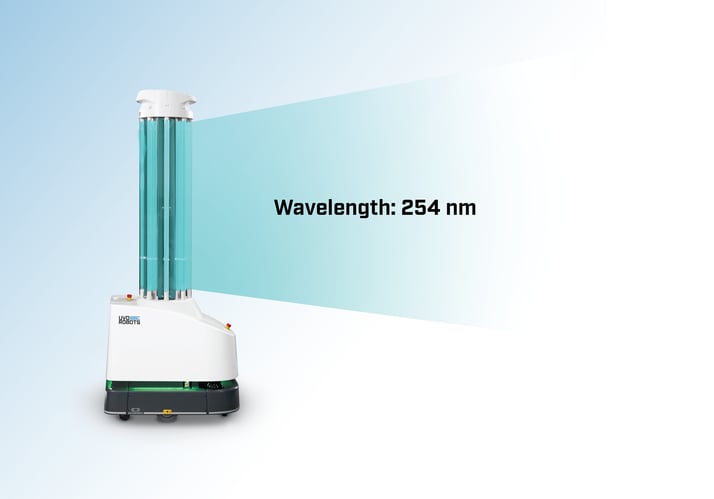
The final physical consideration is the power of the UV-C device, which is determined by lamp strength. While various UV-C devices exist, they typically emit light within the 100-280 nm range, with 254 nm being the most common. The crucial factors governing the generated power are the number of bulbs, their wattage, and their arrangement on the UV device tower. This includes whether the tower uses reflectors behind the lamps to enhance light distribution. Low-pressure mercury vapor bulbs are available in different sizes and wattages. Logically, devices with more bulbs, higher wattage, and the capacity to cover a larger surface area will disinfect environmental surfaces more efficiently. The ability to operate effectively at close proximity is the ideal standard. Choosing the right device is where optimization begins.
Operational Factors: Health of the Device and Human Behaviors
Maintaining the efficacy of any UV-C disinfection program requires addressing both mechanical and human elements.
Addressing Mechanical Wear and Maintenance
Like any mechanical device, UV-C units are subject to wear over time. Lamp life is dependent on the specific type and brand, and disinfection efficacy can decrease as lamp strength diminishes. It is important to assess the quality of the product, as good-quality devices will last for several years or more.
Optimal vendor service programs are critical for monitoring device performance and health. Such a program should include:
Dedicated technicians are essential for a positive customer experience and program optimization.
Mitigating Human Inconsistency with Robotic Technology
Human behavior is a critical factor in the success of a UV-C program. Systems that rely on an operator's judgment for device placement, disinfection time, and work hour availability are highly susceptible to variation and non-compliance. Even highly trained operators face the risk of inconsistency due to human factors like work pressure, personal concerns, or illness.
Robotic technology significantly alleviates the majority of these human inconsistencies. Once an area is mapped and validated, an autonomous robot will execute the scheduled disinfection cycle with perfect repeatability. This engineered approach ensures process consistency, efficiency, and effectiveness. Furthermore, any non-conformance - such as the robot not being able to stop at a designated disinfection point due to a moved object - is flagged as incomplete on the tablet’s dashboard, allowing for prompt corrective action.
Summary
Optimized assessment and configuration is essential for effective UV-C disinfection, as it is far from an exact science. Achieving maximum results requires deep expertise to account for complex factors like irradiation properties, distance, orientation, exposure time, variations in microbes, device specifications, and human interaction. A truly effective UV-C solution goes beyond simple "plug and play"; such an approach is likely to deliver only mediocre results. It is therefore crucial to partner with a company that not only provides autonomous UV-C disinfection technology but also offers the necessary customer support and service programs to fully achieve the goals of your UV program.
Book a demo to see UVD Robots in action
See how UVD Robots delivers autonomous disinfection in real-world environments
1. Boyce JM, Donskey CJ. Understanding ultraviolet light surface decontamination in hospital rooms: A primer. Infect Control Hosp Epidemiol. 2019 Sep;40(9):1030-1035. doi: 10.1017/ice.2019.161. Epub 2019 Jun 18. PMID: 31210119.
2. Cobrado L, Silva-Dias A, Azevedo MM, Rodrigues AG. High-touch surfaces: microbial neighbours at hand. Eur J Clin Microbiol Infect Dis. 2017 Nov;36(11):2053-2062. doi: 10.1007/s10096-017-3042-4. Epub 2017 Jun 25. PMID: 28647859; PMCID: PMC7087772.
3. Kirstein, Franziska, and Rikke Voldsgaard Risager. "Social robots in educational institutions they came to stay: Introducing, evaluating, and securing social robots in daily education." 2016 11th ACM/IEEE International Conference on Human-Robot Interaction (HRI). IEEE, 2016.
4. Jimenez, L. Microbial Landscape of Pharmaceutical Failures: A 21-Year Review of FDA Enforcement Reports. BioTech 2026, 15, 8. https://doi.org/10.3390/biotech15010008
5. Jimenez, L. Microbial Landscape of Pharmaceutical Failures: A 21-Year Review of FDA Enforcement Reports. BioTech 2026, 15, 8. https://doi.org/10.3390/biotech15010008
6. Malayeri, Adel & Mohseni, Madjid & Cairns, Bill. (2016). Fluence (UV Dose) Required to Achieve Incremental Log Inactivation of Bacteria, Protozoa, Viruses and Algae. IUVA News. 18. 4-6.; and, Kowalski, Wladyslaw. (2009). Ultraviolet Germicidal Irradiation Handbook. 10.1007/978-3-642-01999-9_2.
7. Boyce JM, Farrel PA, Towle D, Fekieta R, Aniskiewicz M. Impact of Room Location on UV-C Irradiance and UV-C Dosage and Antimicrobial Effect Delivered by a Mobile UV-C Light Device. Infect Control Hosp Epidemiol. 2016 Jun;37(6):667-72. doi: 10.1017/ice.2016.35. Epub 2016 Mar 23. PMID: 27004524; PMCID: PMC4890342.
8. Geoffrey C Goats, Appropriate Use of the Inverse Square Law, Physiotherapy, Volume 74, Issue 1,1988, Page 8, ISSN 0031-9406, https://doi.org/10.1016/S0031-9406(10)63626-7
9. Boyce JM, Donskey CJ. Understanding ultraviolet light surface decontamination in hospital rooms: A primer. Infect Control Hosp Epidemiol. 2019 Sep;40(9):1030-1035. doi: 10.1017/ice.2019.161. Epub 2019 Jun 18. PMID: 31210119
10. Cadnum, Jennifer & Pearlmutter, Basya & Redmond, Sarah & Jencson, Annette & Benner, Kevin & Donskey, Curtis. (2021). Ultraviolet-C (UV-C) monitoring made simple: Colorimetric indicators to assess delivery of UV-C light by room decontamination devices. Infection Control & Hospital Epidemiology. 43. 1-6. 10.1017/ice.2021.113.